Working with Wicked Problems
blog by Kristiana Stoyanova
Some of the most important challenges we face today are what are often called wicked problems.
They are problems where everyone agrees the harm should stop, and yet it continues. Not necessarily because of bad intentions, but because responsibility is so dispersed that the “perpetrator” has no single face. There is no single cause, no single owner, and no simple solution.
On my last day at Eurochild, I’ve been reflecting on the wicked problem I had the opportunity to work on in Bulgaria over the past twelve months: the separation of children from their families.
It is a striking contradiction. Individually, professionals, policymakers, and institutions largely agree that children should not be separated unnecessarily. And yet, collectively, the system continues to produce the same outcomes.
What many people don’t realise is that a significant number of children growing up in institutions or alternative care actually have families. In many cases, they could have remained together if the right support had been available at the right time. This support is not only — or even primarily — about government intervention. It is also about the presence (or absence) of strong communities, networks, and relationships around families.
From where I see it now, systems change in practice isn’t about pointing fingers or searching for quick fixes. It’s about aligning policies, funding, professional practices, and incentives that quietly, but consistently, shape decisions and lived realities.
Because of this, my role in the work often sat in the background.
If you look at the image below, that’s where you’ll find me — focused on creating the conditions for others to be heard and to be visible. In this case, that meant creating space for people with lived experience to share their stories and advocate for a different outcome. Not only for themselves, but for others too.
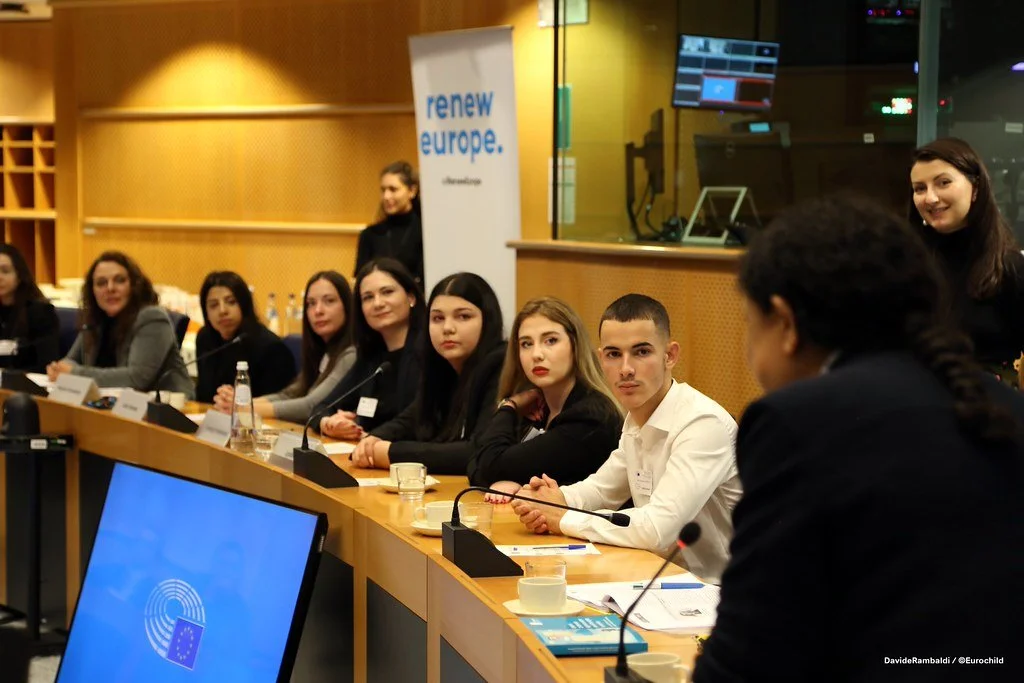
Over the past year, my work involved weaving alliances, supporting advocacy campaigns, and helping ensure that lived experience was not only listened to, but recognised as expertise within policy and decision-making spaces.
This experience reinforced something important for me: systems don’t shift through solutions alone. They shift when power is shared, when narratives change, and when lived experience is treated as expertise rather than an afterthought.
As I close this chapter at Eurochild, I’m deeply grateful to have worked alongside colleagues and partners who stay with complexity, resist easy answers, and keep children’s rights at the centre of long-term change.
Thank you for the trust, the learning, and the shared purpose. 🌱