Where to Begin with Systems Change?
For many years, without even knowing it, I’ve been pursuing an interest in understanding how change happens — and how we might influence it.
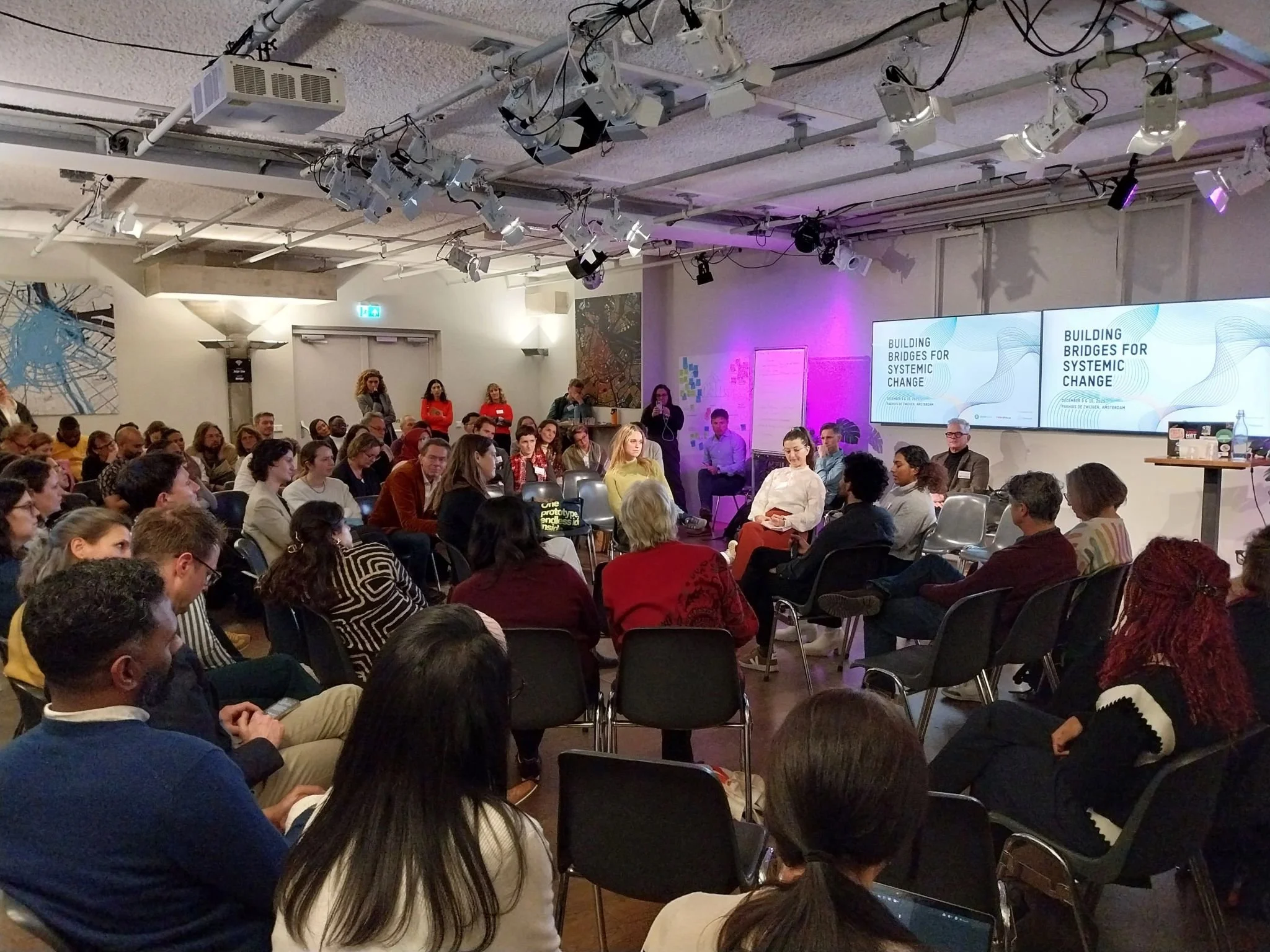
Last week, I attended a (un)conference, ‘Building Bridges for Systemic Change.’ The concept resonated with me deeply — with my whole being, even. For years, I have described myself as someone who aims to build bridges: within oneself and with others.
But following the conference, I realised how deeply my own personal story has been intertwined with systems change all along.
I was born in Bulgaria in 1992 — just three years after one of the most visible transformations of the late twentieth century: the fall of the Berlin Wall. The impact of this singular event — perhaps only the tip of the iceberg — has shaped the lives of almost all humans on Earth. I was undoubtedly born into a regime change, a systems change, and into its long-lasting consequences — consequences that Bulgarians and Eastern Europeans are still grappling with today. But that is a story for another time.
What I want to speak to here is something else: how difficult it often is to talk about systems change. And where do we begin when we start to talk about it?
The Challenge of Talking About Systems Change
It is remarkably easy to slip into abstraction when speaking about systems change — and just as easy to lose people along the way. Some questions immediately emerge: Which system? Who wants to change what? For whom?
These questions surfaced repeatedly at the 2-day event, often silently — more in people’s inner dialogue than in the shared space. Even among a group of around 100 people, many of whom were deeply engaged in this work, a shared understanding was somewhat absent.
It was only in the final hours of the conference that a smaller group of around twelve of us sat down to untangle what systems change actually is — and how we might speak about it in a way that is inclusive and engaging. We were still a large group for such a conversation (maybe 12 to 15 people), even with facilitation. And yet, something worked. We managed to hold the conversation in a way that felt emergent, generative, and participatory.
What follows are a few patterns that surfaced for me in that container — patterns that felt fundamental in shaping a shared mental model of systems change.
1. Systems Change Starts at the Edges
Systems change begins with tension — between what is and what wants to be. There is often an “oil and water” dynamic: two realities that do not easily mix, where one is usually dominant and the other marginalised.
In Bulgaria, for example, it is common for people not to follow procedures and processes, even when they exist. In that context, a systems changer might be someone who insists on following the rules. What is considered “normal” in one system becomes disruptive in another.
This is why systems change so often emerges from the edges rather than the centre. It is at the margins — where friction is felt most strongly — that alternative ways of being and doing become visible.
2. Systems Change Lives Below the Surface
In our circle, several people shared that they had been drawn to systemic change work for years before they had language for it. I recognised this in myself as well.
This work often happens beneath the surface — in the understructures that shape what we see. When I did my first training-for-trainers, the first model I used to explain intercultural competence was the iceberg model. The premise is simple: some aspects of culture are visible — food, rituals, clothing. But below the surface lie values, beliefs, and assumptions that shape those visible expressions.
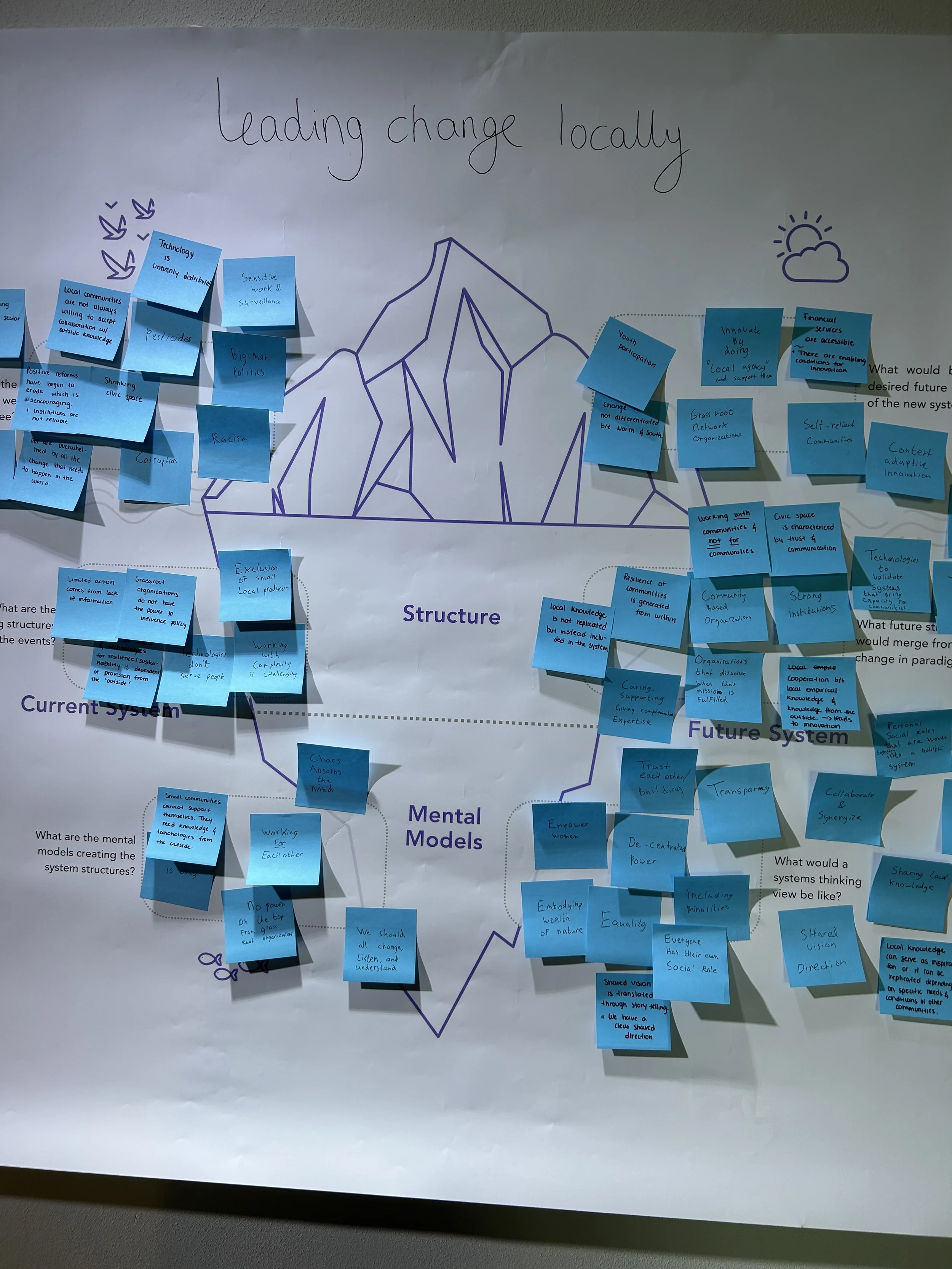
The same is true for systems change. What we notice on the surface — behaviours, policies, outcomes — is rooted in deeper layers that are harder to see, name, and shift. And yet, that is where the real work happens.
3. The Limits of Language
As we spoke, another tension became clear. There is a strong urge — especially among those of us working with complexity — to analyse, categorise, and define systems change. And yet, this task seems almost impossible.
Language and analytical thinking describe reality as it is. But systems change is not only something we describe — it is something we inhabit, something embodied. It is a worldview. A way of relating to ourselves, each other and, of course, complexity.
When it comes to systems change, we step out of linearity and into emergence. Rather than seeking clear definitions, we found it more helpful to think in terms of polarities — tensions that must be held rather than resolved. Polarities seem to stick very well when it comes to systems change.
Some of the polarities that surfaced were:
Complexity ← … → Simplicity
Alignment ← … → Misaligned action
Expertise ← … → Collective intelligence
Prediction ← … → Emergence
These are not problems to be solved, but dynamics to be navigated.
So, Where Do We Begin?
Perhaps systems change does not begin with a definition, a framework, or even a strategy.
Perhaps it begins with noticing tension — in ourselves, in our contexts, in the spaces where something no longer fits. Perhaps it begins at the edges, below the surface, in places where language feels insufficient but something in us still knows.
Looking back, I realise that systems change has been part of my story long before I had words for it. This may be true for many of us. And maybe the real beginning is not about explaining systems change better — but about learning how to stay present to it, together, as it unfolds.
That’s why, together with Rossitsa, we decided to begin our offerings as the Systems Change Collective with an Inner Leadership Gym — an eight-week practice-based journey starting from January 2026 that creates space for noticing, unlearning, and strengthening the inner muscles required to remain present at the edges of change.
Hope this post will help more people to be able to understand, talk about and embody systems change. And hope to see you at the Gym in January!